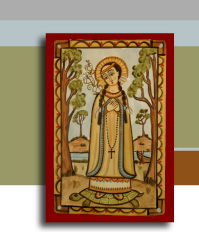
Program One
Medicine Wheel Healing: How It Starts
The story of how one Canadian Aboriginal elder found her way to personal healing and how she passes her knowledge on to others.
To view these movies you need Flash Player. Free download at: get.adobe.com/flashplayer
Materials
- Program One: Medicine Wheel Healing: How It Starts
- "New Directions in Aboriginal Ministry" Building Bridges Project/ Newman College, Edmonton Alberta
- "The Story of Canadian Aboriginal Spirituuality" by Sr. Eva Solomon,. Chapter 3, World Religions: A Canadian Catholic Perspective. Novalis 2010
- Reconciliation: Mission and Ministry in a Changing Social Order. By Fr. Robert J. Schreiter, CPPS. Maryknoll 1992
- Drumming from Within: Tales of Hope and Faith from Canada's North. By +Sylvain Lavoie. Novalish 2009
- Website: Truth and Reconciliation Commission of Canada. www.trc.ca
- Internet access for additional research questions
|
Study Guide
Goal
The goal of Program One is to introduce students to the medicine wheel as a Canadian Catholic Aboriginal approach to healing. Also to introduce students to the history of Canadian Aboriginal Peoples as it relates to healing; why healing is so important today.
Steps
1. Show the internet TV video "Program One: Medicine Wheel Healing; How It Starts"
2. Ask students to form small groups to describe the following impressions from the video:
- Who is Rosella Kinoshameg and what do we find out about her in this video?
- What is the purpose of the Building Bridges Project and who supports it? What is the Truth and Reconciliation Commission of Canada and who is behind it?
- What did you know after viewing the video that you didn’t know before?
- Give three reasons why Canadian Catholics should support the work of the Building Bridges Project.
3. Option for Take-Home Assignment
1. Via the Internet find more facts about:
- The history of Truth and Reconciliation Commission (TRC) of Canada and its current work.
- Name 10 Canadian dioceses where Catholic Aboriginal peoples live, and provide 5 important facts about the social conditions for the Catholic Aboriginal pupulations which live there.
2. In groups, make presentations to the class about any or all of the
above. Include suggestions on how students could become more involved.
|